

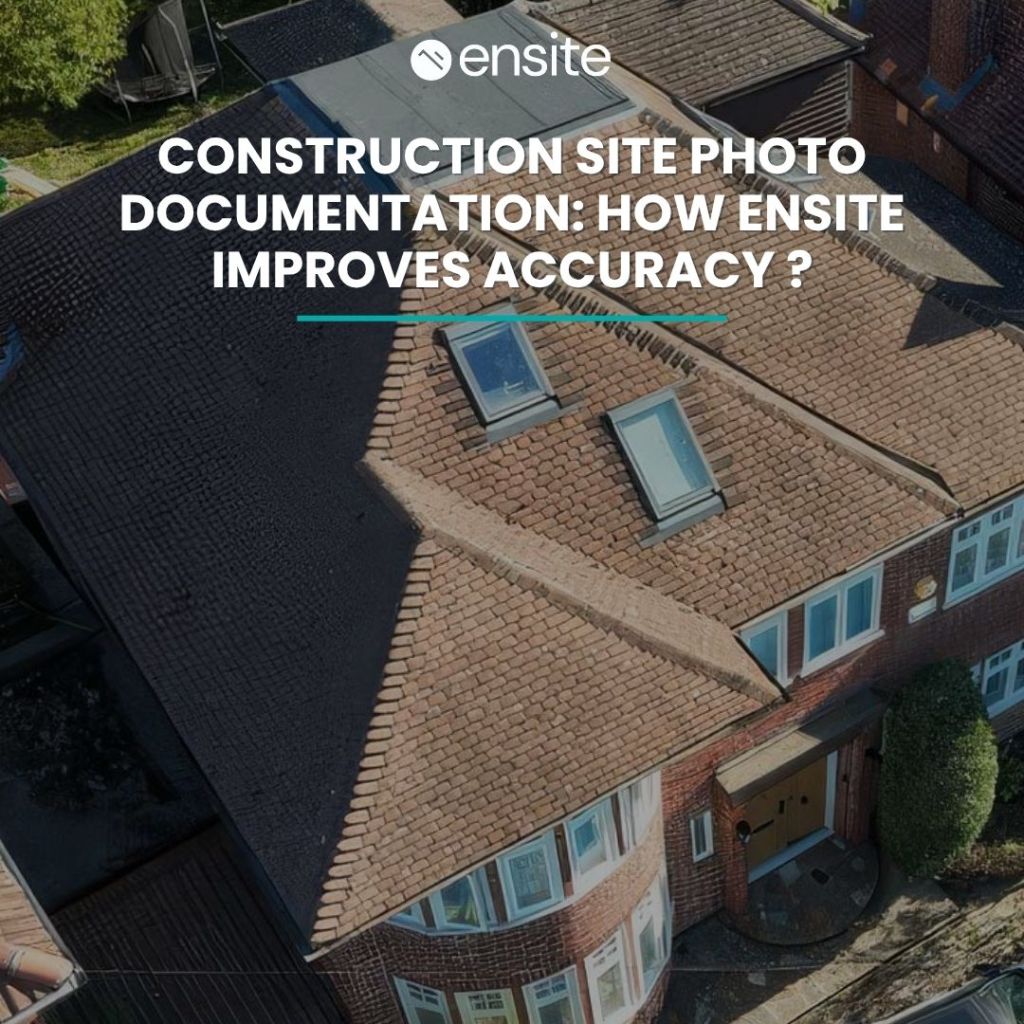
Construction Site Photo Documentation: How Ensite Improves Site Surveys and Project Accuracy
Many construction delays are blamed on labor shortages, permit timelines, procurement gaps, or scheduling conflicts. Those issues are real, but they are often secondary. In many cases, project friction begins much earlier—during the survey stage, when incomplete field information is passed downstream as usable data.
That problem appears in familiar ways. Designers request more images after engineering has started. Estimators revise assumptions when hidden site conditions surface. Project managers reschedule crews because access constraints were never captured properly. Each issue looks separate, yet the source is often the same: weak documentation.
This is why construction site photo documentation is no longer a back-office task. It is an operational control point that affects planning accuracy, speed of execution, and project margins. Strong jobsite photo documentation gives internal teams verified site intelligence before money, labor, and timelines are committed.
Ensite helps solve that challenge through nationwide field coverage and disciplined documentation standards built for construction, solar, roofing, and inspection programs.
What Is Construction Site Photo Documentation?
Many companies define documentation too loosely. If enough photos were taken, they assume the job was done well. That standard creates volume, not clarity.
Effective construction site photo documentation is the structured capture of visual information that helps another stakeholder make a better decision. Each image should answer a question, validate a condition, or remove uncertainty from the next stage of the project.
More Than Basic Photos
A roof image should do more than show a roof. It should reveal penetrations, surface condition, access paths, drainage patterns, obstructions, and usable work areas. An electrical image should help reviewers assess panel location, available space, labeling, and surrounding constraints.
That is the difference between random pictures and professional construction photo documentation.
Why Does It Matter Operationally?
Good documentation shortens review cycles, improves estimating accuracy, and reduces field surprises. Poor documentation does the opposite. It slows decision-making because teams are forced to work around missing context.
Why Do Growing Companies Need It Most?
As project volume increases, inconsistent survey quality becomes harder to absorb. Strong construction site photo documentation creates repeatable standards that scale with growth.
Why Poor Site Documentation Quietly Becomes Expensive?
Weak documentation rarely shows up on reports as the main issue. Instead, it hides inside rework, delays, lower productivity, and margin loss.
Estimating Errors and Defensive Pricing
When site conditions are unclear, estimators often compensate with assumptions or contingency pricing. That may reduce internal risk, but it can also make proposals less competitive or distort expected profitability.
Design Delays and Revisions
If design teams receive incomplete visuals, they pause progress to request missing details or redesign around uncertainty. Those extra loops slow internal throughput and create avoidable handoffs.
Field Productivity Losses
Crews lose productive hours when actual site conditions differ from documented conditions. Access limitations, staging problems, hidden obstructions, or inaccurate measurements reduce installation efficiency immediately.
Disputes Without Evidence
Clear construction site inspection photos often become the most reliable record of pre-existing conditions or completed work. Without them, disagreements take longer to resolve.
Margin Leakage at Scale
One weak survey may seem manageable. Fifty weak surveys create measurable drag. This is where construction project documentation becomes a financial lever, not an admin exercise.
The Most Common Documentation Gaps That Hurt Projects
Most documentation failures are predictable. They happen because teams capture what is visible rather than what is operationally useful.
Missing Orientation Context: Close-up photos of equipment are far less useful if no wide-angle image shows where that equipment sits within the site. Office teams need layout context to plan effectively.
Uncaptured Constraints: Access gates, stair limits, narrow walkways, neighboring structures, roof setbacks, drainage issues, or tenant activity zones are commonly missed. These often create the real delays later.
Weak Condition Evidence: Surface wear, corrosion, cracks, damage, or obsolete infrastructure may be photographed casually rather than clearly. That weakens planning confidence and can lead to scope changes.
Inconsistent Survey Standards: Large contractors operating across multiple markets often receive different documentation styles from different field resources. Internal review becomes slower because every package requires interpretation.
Poor File Organization: Even strong visuals lose value when files are unlabeled or difficult to navigate. Fast-moving teams need usable packages, not digital clutter. Strong site inspection documentation solves these issues through consistency and purpose.
What High-Performing Teams Capture Differently?
Well-run organizations treat documentation as a system rather than a task.
Orientation Photos: These establish site layout, entrances, elevations, work zones, neighboring conditions, and general access. They help internal teams mentally map the property.
Relational Photos: These show how assets connect to one another. Meter to panel. Roof hatch to pathway. Equipment to clearance area. They are critical for planning movement and installation flow.
Evidence Photos: These confirm exact conditions such as labels, damage points, corrosion, cracks, or structural details. They reduce ambiguity during review.
Decision Photos: These are taken because another department needs them to proceed. High-performing teams do not just document what they see they document what others need.
How Ensite Improves Site Surveys and Project Accuracy?
Many vendors can schedule a site visit. Far fewer can deliver field data that internal teams trust immediately.
Standardized Documentation Across Markets
Ensite uses consistent capture frameworks so clients receive dependable outputs across regions, property types, and project volumes. That matters when scaling operations.
Field Professionals Who Understand Downstream Needs
Experienced surveyors know which details estimators, designers, operations teams, and installers need. They capture more than visible assets—they capture decision-critical context.
Quality Review Before Delivery
Documentation is reviewed for completeness, clarity, and usability before handoff. This reduces back-and-forth and shortens internal response times.
Faster Internal Workflows
Better construction site reporting means design, estimating, and project teams can move faster because fewer clarifications are required.
Scale Without Quality Drift
Many providers offer reach. Ensite combines reach with standards, which is harder to maintain over time.
Why Does This Matter for Solar and Roofing?
Different industries have different scopes, but they all depend on accurate site inputs.
Solar Projects
Missed survey details can affect array layout, conduit routing, main panel upgrades, structural assumptions, and installation readiness. Strong solar site survey documentation supports smoother engineering and deployment.
Roofing Projects
Clear visuals help assess membrane wear, flashing condition, penetrations, drainage patterns, and access safety before crews mobilize.
Multi-Site Commercial Programs
Organizations managing multiple locations need consistent construction site photo documentation standards across every property, not a different process each time.
Best Practices for Better Construction Site Photo Documentation
Teams can improve outcomes significantly with repeatable standards.
Use a Fixed Site Walk Sequence: A consistent path reduces missed areas and creates predictable outputs.
Capture Wide First, Detail Second: Context should come before close-ups. Teams need to understand where the detail exists.
Photograph Constraints With Equal Priority: Assets matter, but constraints often cause the real delays.
Label Files for Speed: Organize folders by roof, electrical, structural, access, or damage categories. Fast retrieval improves internal efficiency.
Pair Photos With Notes: Measurements, observations, or condition notes increase the usefulness of visuals. Strong jobsite documentation best practices rely on both.
Review Before Submission: A short QA step prevents avoidable revision cycles later.
Why Do Growing Teams Choose Ensite?
As volume increases, internal documentation becomes harder to manage. Coverage gaps appear. Output quality varies. Scheduling consumes admin time. Regional inconsistency grows.
Lower Coordination Burden: Ensite reduces the need to manage fragmented field resources across markets.
Better Planning Inputs: Reliable deliverables help internal teams estimate, design, and schedule with more confidence.
Flexible Capacity: Organizations can scale survey volume without rebuilding internal field operations.
Stronger Consistency: Standardized outputs create faster internal review cycles.
Last Thought
Projects move faster when decisions are based on verified conditions. They slow down when teams inherit assumptions disguised as data.
That is the real value of construction site photo documentation. It protects planning accuracy, improves execution readiness, and reduces preventable friction across the project lifecycle.
Ensite helps construction, solar and roofing organizations capture dependable field intelligence at scale. With stronger documentation inputs, teams can estimate smarter, design faster, schedule better, and execute with greater confidence.